
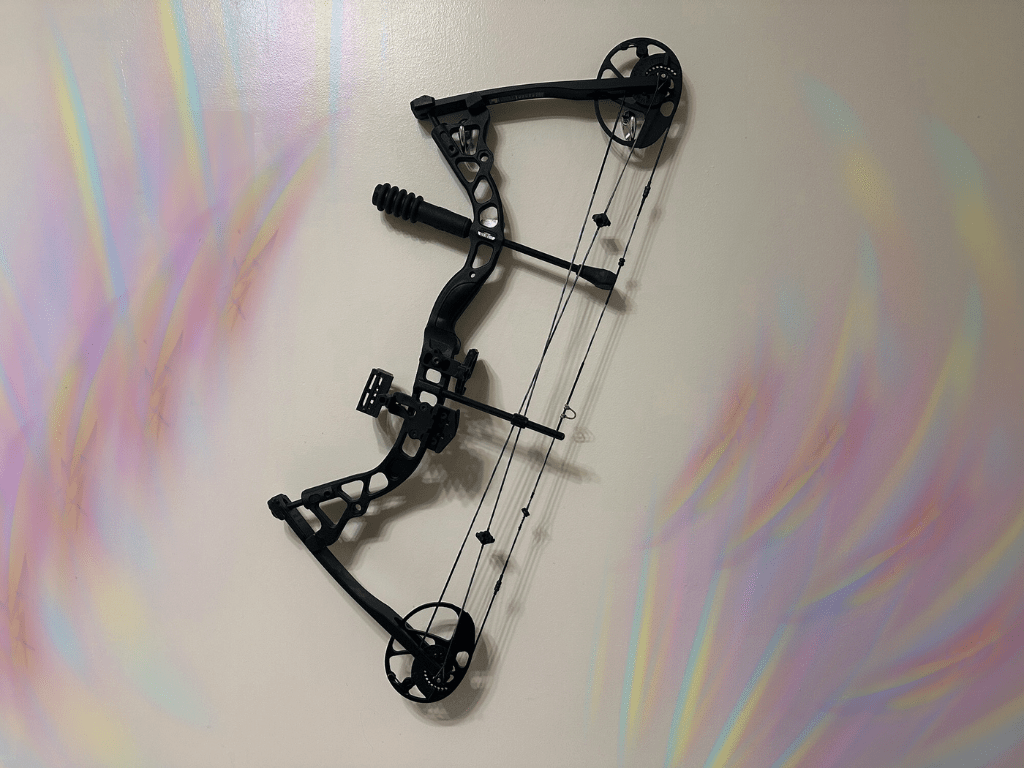
As an upbeat autistic woman who has experienced a lot of trauma, I’m regularly confronted with extreme thoughts and emotions, often so intense and varied that they conflict with each other. A simple example would be seeing myself as lovely in the bathroom mirror while I’m getting ready alone and then feeling downright heinous as I’m wading through a river of dewy, well-coiffed people at Blue Bottle Coffee. Dissonance like this proved to be a source of confusion and even chaos in my younger years, but I’ve adopted a metaphor to help me navigate such disorienting polarization: my goal is to string the bow.
Successfully stringing a bow means achieving the appropriate tension between two opposing points. For my previous example, a properly strung bow might sound like this: “I’m a decently attractive middle-aged woman, especially when I make a thoughtful, concerted effort with my looks; but I’m not objectively gorgeous to society, nor will I be without drastic, expensive intervention.” Measured, balanced, accurate – I can shoot with that repeatedly. It’s definitely not a zinger though, hah. And I know that in the short-term, it would be far easier to just ride the highs and lows of each simple thought without thinking about how they conflict. However, doing so would be a dramatic and inauthentic way for me to live, which isn’t ideal for maintaining an even keel nor building solid relationships.
Here’s a more social example involving the movie Mickey 17, which stars Robert Pattinson as a tormented worker who can be reincarnated countless times as his questionable employer colonizes a distant planet. The other night I suggested watching it to a fellow traumatized autistic woman, who immediately and passionately replied that she doesn’t like science fiction. Wait what? Except she’s such a fangirl for Star Wars that she recently obtained a ridiculously impractical cooler shaped like a nearly life-sized R2-D2. Oh, and on a beach trip to Florida several years ago, we took a day’s detour to Disney World specifically to visit Galaxy’s Edge so she could vibe out in Batuu; she even made her own light saber.
So what might a proper bow statement look like here? If she’s willing to be an accommodating pal that evening, it might be something like “I’m pretty picky with my sci-fi; what do the reviews say?” And if she’s truly intolerant of what I’m curious about, it still would’ve helped our relationship for her to acknowledge the nuance in her perspective: “Hmmm… I think Star Wars is the only sci-fi I like. This doesn’t seem similar, so I’d rather watch something else.” Because when she so assertively dishes out a negative blanket statement I know to be false, I’m left wondering if something is wrong, either in her life generally or due to something I did or said, or if I’m otherwise just not worth a thoughtful, grounded response at that moment. (We sorted out movie night, though, and saw Mountainhead instead.)
Successfully completing a bow exercise like this requires some humbleness, total honesty, and ongoing mindfulness: being aware of oneself and how one’s opinions and perspectives may differ; understanding the contexts and factors influencing those differences, as well as the interplay among them all; and using accurate instead of exaggerated language, regardless of how potent one’s feelings on a given subject may seem.
I remember the first time I consciously encountered extreme polarization within myself and resolved it. As an 18-year-old girl whose only physical activity amounted to frisbee golf, fishing, and standing around at my retail job, I realized I’d gotten embarrassingly out of shape towards the end of my senior year. The playful potbelly of my childhood had gained womanly dimples and folds, and the bright blue Tommy Hilfiger tankini I had bought hardly masked it.
Determined to fix my unsightly bulges, I adopted a workout routine to do after school each day. But I regularly found myself laying on the floor, unmoving, telling myself in my head how much I didn’t want to do it. Even screaming against it sometimes. Then my mind’s eye would see me lazing around my boyfriend’s pool or surrounded by svelte classmates at beach week, and another part of me would shout back that we in fact did want to start those crunches. This emotional tug-of-war went on for days, and it could last an hour or more at a time. Exhausting right?
I finally got through it with the solution to mostly override my current feelings for the sake of my future ones. I understood what I was feeling in that moment reflected where I was in that moment: unhealthy. I couldn’t reasonably expect my misshapen body to spontaneously feel compelled to engage in activity contrary to its reality (i.e., for flab to be drawn to exercising). But if I clung to those lazy feelings then I would be stuck in that lumpy reality – so if I wanted to be fit in the future, I needed to embrace feelings of fitness now, which meant nurturing my latent muscles to be hungry for shredding and quietly dismissing anything contrary.
Exercise became not a question of if but when. I set a firm schedule of exercising five days a week with flexibility for deciding which days to be active based on how I felt and what other work I had going on. At first this resulted in cramming all exercise into the last five days of the week, because the internal signals I’d receive would consistently tell me I was too tired or otherwise deserved a break, maybe because a customer had snapped at me or I’d done poorly on a test. But over time, as I’d push through the chronic resistance on days when I didn’t give myself the option to back out, I realized that most of those discouraging messages were actually not worth indulging – instead of helping me, they kept me stuck in a place of weakness and self-pity.
I continue to string bows between present and future states for the sake of growth, finding the tension between honoring who I naturally am and cultivating who I want to be. There’s no doubt that it’s an ongoing challenge, often full of back and forth deliberations as I find the right balance between comfort and progress. And this dichotomy is probably a significant factor that makes socializing more difficult for me, even online.
I typically enjoy the passive camaraderie created by autistic influencers on social media, with their posts and the comments of their followers resonating deeply with me. But sometimes my feed becomes frustrating and claustrophobic. In the quest to spread autism awareness and self-acceptance, some messaging inspires me to entrench traits that I’m actively nurturing in a more constructive direction.
When I focus on how easily autistic and ADHD people get misunderstood or manipulated, I start shrinking from my plans to go networking again. If I’m scrolling on my phone and harmonizing with the chorus that we struggle to express ourselves, I come home to write and find my keyboard covered in cement. The autistic mind is its own echo chamber and can easily overwhelm itself, so combining it with the algorithms of social media and the power of all those other synced up autistic minds can create an energetic avalanche of sentiment that risks burying me and my aspirations.
This isn’t at all to say that reflection and introspection are foolish – they’re necessary to understand and accept who we are before we can work towards true change. But that’s different than ruminating on who we are, especially the parts of ourselves that don’t serve us well. Because our thoughts are like water, and the grass where we put it will grow, it’s wise to be mindful of what we’re watering. So my internet time is yet another bow I’m stringing: too much and I’m adrift in reminders of my challenges and failures, but not enough and I’m deprived of knowledge, possible solutions, and the loose sense of community that exists in the virtual world.
As I’m stringing all these bows, I’m also weaving them together, with their philosophies and beliefs creating a tapestry of my personality. They end up functioning like a trampoline, working in concert to respond to various stimuli and behave in ways that are seen as me. And it’s all a continuous process, as the feedback from my experiences can influence adjustments to my bows, altering the fabric of my reality and who I am to the world.
The concept of stringing a bow applies outside of oneself too. A healthy, successful relationship is a great example, where neither person dominates. And a well-run business that fairly gives and takes is an admirably strung bow. Using natural resources without exploiting or depleting them is another worthwhile one.
Finding peace in the duality of our existence – achieving the right tension between the dark and the light – is the big bow we’re all stringing together, whether each individual realizes it or not. And assuming it’s even possible, healing all the pain in the world would therefore unravel reality as we know it. I know that may sound scary, but we’d enter a kingdom of transcendence.


 Trautism
Leave a comment