

As I continue to reacquaint myself with my past, I found a paper, “Social Dance Project,” that I wrote in college when I was 21. It’s beautifully naive and reeks of autism. While I did it as an assignment for a dance class, it’s representative of how I’ve typically coped with overwhelming situations: analyze, analyze, analyze – and then kindly seek to understand and accept the common threads of humanity that bind us together. Unfortunately the paper strikes me as a rush job, but I’m leaving it as-is for the sake of authenticity, with the exception of some helpful clarifications. I’m also including the original photos, even though they amount to tiny thumbnails of pixelated stick figures.
The event that I studied on October 25, 2003, took place at Glow, the dance party held at Club Insomnia every Saturday night. It is only a few short blocks from the MCI Center in Washington, DC. A friend called earlier that day to invite us to a farewell celebration for one of his friends who is moving to England in a few weeks. Although we did not know the guy [who is moving] personally, a good rule of thumb for partying downtown is the more, the merrier. So we all agreed to meet outside the club at 10:30 p.m., an early start in order to stake out a good spot for so many people.
Inside, the environment was representative of a typical techno-dance club: dark, loud, and a swirl of shapes and smells. One large dance floor, flanked by two bars, occupied the center of the space and the main DJ booth stood in front overlooking the crowd. Directly across the sea of undulating bodies from the DJ was one of the three VIP sections, separated from outsiders by a fabric wall and security guards. We spent most of our time here, sitting on plush leather couches and drinking the bottles of Grey Goose we bought in order to be graced with the [VIP] privilege. The two other VIP sections were on the second floor along with the salsa room, all with a bird’s eye view of the main floor. The somewhat isolated third floor housed the hip-hop fans. I did not leave the neon lasers and flashing lights of the first floor on this occasion but know the third floor’s general layout from previous visits. Other décor included odd, glowing shapes sticking out of the ceilings and walls, and the random shower of confetti.
Dance was central to the environment, as indicated by the layout. It was also quite important to the type of event that we were participating in because it allowed everyone, even people with only vague associations through friends-of-friends, to enjoy one another’s company as easily as someone they are very close to. Dancing is a universal language so the awkwardness that can accompany forced, shallow talk amid otherwise silence or bar racket did not exist. Everyone came to have a good time at [their] own pace and interact with others as much or as little as they wanted. The freedom of dance made this possible.
In the most basic terms, the music was techno. Techno has many different genres, the definitions of which can generally be found in the [ear] of the beholder [due to their similarities and overlap]. I would call [this night’s genre] trance, with some highlights of breakbeats. This type of music allows anyone willing to express [themselves] in almost any way they please. The theme of freedom appears again because you can pick up on any sequence of sounds and truly dance to the rhythm of your own personal drummer, if you decide to dance at all. If not, entertainment can be found in the crowd or DJ booth.
I am the type of person [who] has a very difficult time not dancing when I hear good music so I happily danced the night away with my husband, others in the group, and just by myself. Every now and then I would sit down and talk with people over the thumping of the music or just sit back and survey the scene. The same was true for almost all the clubbers that I saw; the interactions between people were very casual. A couple would be dancing and then break apart to dance alone, with another partner or partners, or simply engage in another activity like drinking, standing, sitting down, or walking around. Some people danced solo the whole time with only their glow sticks or beer as a mate.
The dancing that I witnessed epitomizes the culture in which we live – anything goes. There are no gender-specific movements, and each sex approaches the opposite (or the same!) sex just as easily as the other way around. Couple dancing in this environment, though, is a far cry [from] what is traditionally deemed as such. There are generally two ways to tell if two people are dancing together: their bodies are either grinding so hard that it would be a miracle if there is no actual procreation, or the only contact they seem to have is looking at each other and possibly smiling every now and then. I prefer the second! Like everyday life in America, the dancing had a very obvious individualistic component. Everyone moved at different speeds and manners, and displayed varied levels of experience, talent, and for some, almost certainly practice. People often dance to be seen so without any watchful eyes [of being at the club], I think the fuel behind some of the fires could subside. With exhibitionism playing such an important role, there is no division between a participant and an observer; I happily wiggled and giggled on either side of the looking glass as long as the exchange [of energy] was within our group of friends.
With one noted exception that night, I see no point in branching out to strangers in an environment that admittedly holds potential dangers. Perhaps I stepped out of the bubble we had created because these two gentlemen caught my attention by looking so out of place. They were young guys, not older than twenty-one, and clearly a cultural mismatch for the club as they were decked out in their full formal military attire. Hoping they had come from a wedding or other such celebratory event, I approached them and asked. They explained they had simply walked off the base for a night on the town… and the cute one even asked me to dance! (Being married, of course, I declined). However, by asking such a question with words instead of just shimmying up to me, he further cemented the impression that they were fish out of water. Polite, but not speaking the same body language as everybody else!
There are several perceptual filters that could have influenced my opinion [of the social dance experience that night]. First and probably foremost, I love techno. Now when I listen to music with lyrics, particularly modern music, I find myself getting irritated that the words are not matching up with the version of the song I am playing in my head. To see the endless number of ways the music can be interpreted [through dance] is astonishing and speaks volumes about [the individuality and creativity of] the human race as a whole. Another filter is that I am young and like to party with my friends. So it satisfies me to an extent to dance and drink with a nice group of people and [I] have no problem being around people who are enjoying themselves as freely. I am also Catholic, which may be why dancing in a public club without touching another person is enticing and why certain respect for others is still important even in such a liberal place. It is nice to see all walks of life getting along and appreciating the same thing, and a fundamental principle of this is respect. To take this one step further, I have high standards for what is appropriate behavior at work, in school, and around family, so I embrace an opportunity to temporarily abandon such rigid constructs. I do not find it offensive to see others expressing otherwise concealed sides of themselves. From my point of view, it was a wonderful time and I keep smiling to myself as the memories flutter across my eyes; they cast colorful little phantoms on each day’s tedious tasks! Spending a night at the right club, particularly with a good group of people, can be an exciting, happy, and liberating experience. Without the dancing it would just be a bar… complete with all the blabbering, drunken strangers.
Attached documents:
- Wristbands in place of tickets for admission into Glow.
- Flyers that were handed out to us as we exited the club, in place of a program of events for that night. I imagine that the reason behind not providing documentation regarding the night that you are attending is because the promoters have already gotten the attendees to pay for the event. There is no point in advertising a product you have already sold, though it is a great marketing tactic to get repeat customers for weekends in the future.
- Cameras were not permitted inside the club or anywhere near the outside. In lieu of actual pictures of that evening, then, photos of typical club dancing were taken from the website of the Velvet Room, a techno dance club in Atlanta, Georgia. I looked for copyright information but could not find any. Due to time constraints and the nature of the use, I did not try to write the club.
Key Concept: Collective Individuals

In the above pictures are individuals dancing in their own unique way or witnessing others doing so. Everyone is together in the same general area, either under a disco ball or chandelier, but expressing themselves in whatever way they deem appropriate. Sticking your hands in the air appears to be a common move!
Note how the ambience helps those who may normally be restrained to let go of their inhibitions. The dark atmosphere with neon flashing and strobe lights help. Or maybe it’s just the alcohol that can be seen in most of the hands of the participants…
Key Concept: Any Couple Dancing Goes

The traditional ballroom style of American dancing is out the window to be replaced by an “anything goes” mentality. The couple in the middle is dancing together although not looking at each other and clearly not moving in similar motions. Looking absolutely fabulous is also a staple in couple dancing, particularly same sex couples!
Note the strategically placed photos of a picture of one male and female dancing that is sandwiched between pictures of girls hugging on girls. On the club scene, [girls acting like this with each other] is a more frequent sight than one might imagine!
Key Concept: Dr. Jekyll and Mr. Hyde Syndrome
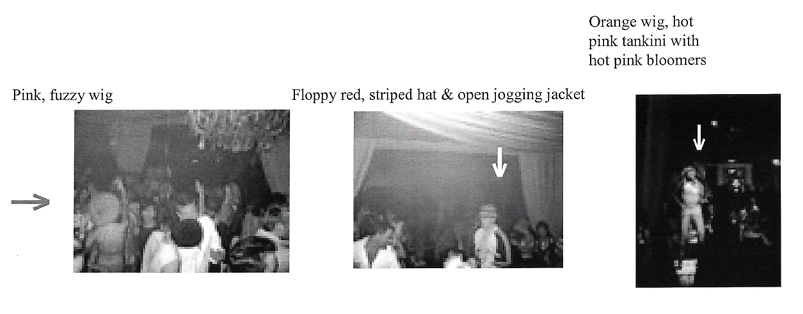
By looking at the above pictures, even without the arrow, it is relatively easy to see which clubbers may not be dressed in their everyday attire.
It is common for partiers to not only dress differently than they normally would but also dance, drink, talk, and act out of character! Instead of calling them “fake” it is generally nicer to say that they are [releasing] a side of their personality that simply does not get out for air that often.
Key Concept: The Art of Glow Sticks

The camera has managed to capture the true essence of dancing with glow sticks as seen in the three pictures above. By twirling, spinning, and looping their hands in a variety of intricate, creative patterns, different shapes are formed by the afterglow. To those mastering such eye trickery, much coordination is required.
Although not obvious in these particular moments frozen in time, proximity to glow sticks is generally a good indication of which clubbers are toying with drugs that evening. Not so much in terms of the glow stick master or even the immediate appreciative audience, but the person who becomes paralyzed and truly entranced by the oh-so-pretty neon chemical sticks.
Without having the knowledge to understand it as such back in 2003, I clearly saw nightclubs as safe spaces where autistic masking wasn’t necessary, and I loved them for it. As long as you maintained basic respect, and played by the simple rules of whatever club or party you were attending (e.g., no photography, wear all white, etc.), you were welcome to conduct yourself and express yourself however you wished. Even awkwardness was okay, but in the face of so much fun and tolerance (and mind- and mood-altering substances), anyone’s lingering discomfort usually just melted away… it was like Mardi Gras, except it could happen every weekend. The ethos of this minimally restrained bacchanalia was captured in the popular mantra PLUR, which I immediately and thoroughly embraced. It stands for Peace, Love, Unity, and Respect, and it was born from the rave culture that missed me but inspired many of my clubbing experiences.
Dancing with abandon for hours at a time had the added benefit of expelling many of the emotions and energies that would get trapped in me, especially as someone so deeply sensitive and chronically overwhelmed. I thought I was just blowing off steam like a more normal person, but I can see now that the intensity of my dancing and many of my other partying behaviors often eclipsed those of the revelers around me. This extremely effective form of release and exercise is what I missed most when I got pregnant less than two years later, and back then it didn’t even occur to me that I could just pop on some awesome tunes and dance all by myself in the privacy of my own home. Or maybe I tried, but I didn’t yet know how to create the right vibe in my head. Or maybe, subconsciously, it was too painful to take my primary social activity and suddenly make it a solo hobby.
The importance of friends and community, and the social value I’d assigned to clubbing, shine through in several different parts of the paper. I explicitly stated that I like to drink and party with my friends, implying it’s because I’m young. I also said I was happy to dance and talk with whoever was in our group, and I noted that dancing in such an environment creates quick and easy intimacy among participants, especially when one has a “nice group” or a “good group” of people. Plus of course the impetus for going out that night was to say goodbye to someone we didn’t even know – but my husband and I went because we felt like we were answering the call of duty to our network. Despite this rather loose collection of friends, though, I pointed out that it remained important for us to interact with only those we knew directly or by association, unless we had a very good reason for straying from the pack.
In my paper, I theorized that I stepped out of our friend “bubble” to talk to the military guys that night because they seemed so out of place, but I don’t explain why that makes sense – now I’m guessing one of my goals was to help them feel welcome in an unfamiliar environment. Not only could I regularly relate to such a position, but I’ve also tended to reflexively leap to meet the needs and desires of others, especially if I’m intoxicated in any way. I inadvertently hint at this caretaking mentality when I refer to them as “young guys, not older than twenty-one” even though that was my age at the time too. But I’d already experienced a fair amount of the world by then, and my husband and most of our friends were significantly older than me, so I seem to have either surreptitiously or subconsciously lumped myself in with the older age bracket instead of my real one.
Approaching the young men doesn’t seem like purely an act of service though. I see a discreet clue about a more selfish motive when I say I was “hoping they had come from a wedding or other such celebratory event.” But why would I hope for that to be true? How would that benefit me? I’m concluding it would have served as an itty bitty energetic Easter egg. Having recently experienced a happy celebration would have almost surely imbued them with extra positive energy, and if I asked them about it, they’d share it with me and we’d amplify it… so, my wandering served the additional purpose of possibly capturing some more metaphorical tinsel to put on the festivities with my friends. And maybe they could have ended up getting welcomed into the larger group, at least for a test drive: “Hey everyone, these two servicemen just came from the most beautiful wedding at the Andrew Mellon Auditorium! Woo!!!”
My outreach is particularly funny when juxtaposed with my repeated commentary about avoiding the bar scene because of all the small talk with drunk strangers. Besides the high likelihood for shallow, boring conversations – which just inspire me to drink more – part of the unpleasantness of most bar chatting, at least for me, is the danger of accidentally getting too close by being overly friendly. I’m usually quite in touch with my love for others and our collective connectedness, and I’m curious and seek out meaningful conversations, so especially when all that combines with very high levels of intoxication, my dynamic can become destructively confusing for everyone involved, including myself. This is especially true in a place like a bar, where the options for what to do are limited to drinking more, talking more, eating, or sitting closer together – or moving further apart, which usually doesn’t feel very nice or fun in such a setting. But dancing gave me something else to do, and I knew how to avoid getting too close to people on the dance floor. Additionally, a club’s crowded and chaotic environment afforded abundant opportunities to create swift and graceful distance from someone if desired. I witnessed very few hurt feelings during my seven years of clubbing, and with plentiful distractions, people tended to get over any offense quickly… plus it helped that bouncers would reliably pop out of the shadows to deal with anyone who decided to have a problem instead of getting along.
Those were wild years: interesting and fun, yet damaging and wasteful. The endless variety, novelty, and flexibility afforded by the club scene satiated my undiagnosed ADHD and freed my stymied emotions, while the minimal but strictly enforced rules created a delightful sandbox for me to experience social fun and intimacy despite my undiagnosed autism and overloaded schedule. I wish I had seen it for its other roles in my life though, beneath that mottled shiny surface – a crutch, a phantom, a trickster. I’ve since learned that friends made so quickly and easily are often lost the same way. And just because a night’s behaviors are accepted, or even celebrated, it doesn’t mean they can’t be a liability to one’s reputation and beyond. If I’d been more aware of those impacts as a young person, maybe I would have found a different outlet for my emotions and a better solution for building a social network, but I’m grateful for all the memories that are good. And I’ve learned from the ones that aren’t. I’m obviously keeping PLUR, though, haha!


 Trautism
Leave a comment