
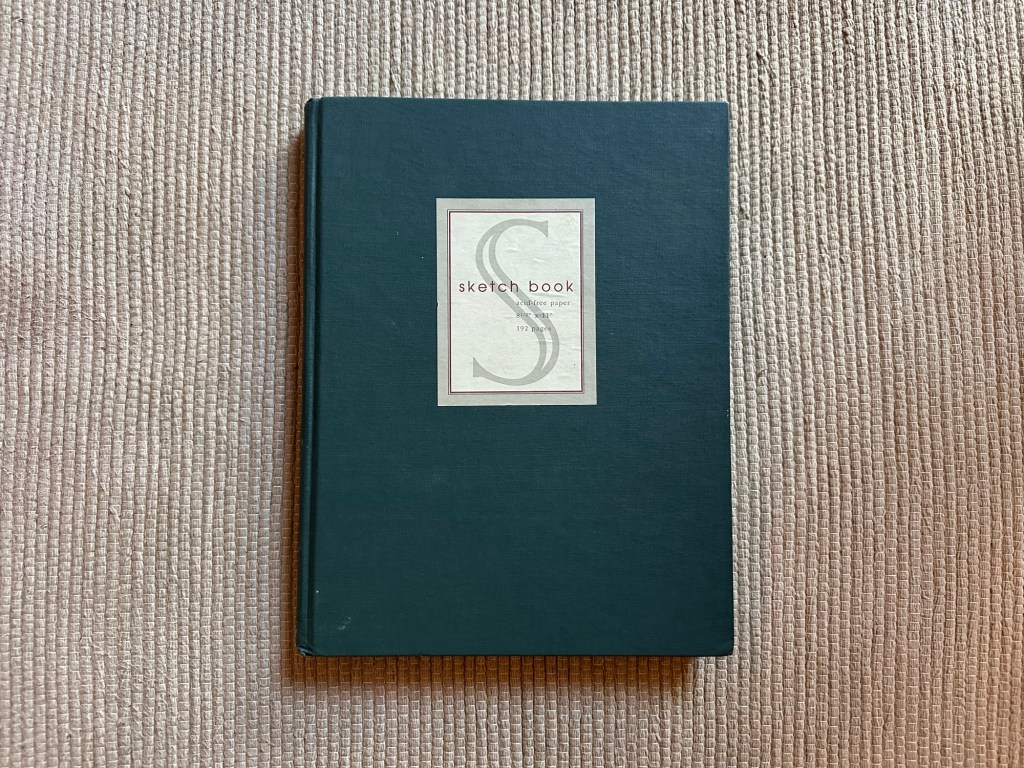
As I’ve continued to sort through the mysteries lurking within my personal belongings, I found another rare artifact of self-expression from my youth: my old sketchbook. I recognized the forest green cover immediately, as no trip or other big adventure of mine as a teen was complete without it. Yet holding it in my middle-aged hands, I struggled to remember more than a couple of images I’d drawn within its pages. It was a little disconcerting, especially for something so meaningful, but I understood better once I flipped through it.
For as much of a fixture as it was during my teenage years, this sketchbook contains surprisingly little content. My first drawing is from December 1996, so the book must have been a Christmas present. The brilliantly white, acid-free smoothness was a major upgrade from the beige construction paper I’d been awkwardly using to paint the prior month, when my form of art therapy meant painstakingly recreating strange characters from my pog collection.
Over the next few months of ninth grade, I’d go on to sketch a total of eight images. I’m not sure if it’s owing to the time of year or a shift in my mindset, but half of them are religious: Jesus himself, fashioned after an 8” bust that still sits by my bed and was handed down from my mom; a decorative cross that says “JESUS SAVES”, where Jesus is written horizontally, with its “S” sprouting the start of “SAVES” written vertically, and a dove occupying the top of the cross; a religious emblem of two rather realistically shaped hearts – one sprouting a flower, the other sprouting a cross, both ringed with thorns and pierced by the same sword as if they were a two-bite appetizer on a toothpick, complete with drops of blood, all hanging above the stylized words “PLEASE GUIDE ME”; and finally, the crowned Virgin Mary holding a haloed baby Jesus. Among the religious imagery is an unusual flower with small clusters of buds and large leaves, along with a rendering of Claire Danes as Juliet from Baz Luhrman’s 1996 film of William Shakespeare’s Romeo + Juliet. Her elbows rest on a broad stone balcony as she gazes thoughtfully at fireworks beyond the frame, lovestruck from having just met Romeo. The subject matter is ironic because I drew only two more times in this era of my life before getting seriously distracted by a boy.
The abrupt end to my art coincides with when I started dating my long-time boyfriend in April 1997, although it’s possible I was already getting restless with my new hobby anyway – my last two drawings depict Tigger from Winnie the Pooh, but I struggle to think of why I would have cared about that character enough to memorialize him in my sketchbook, especially twice. But regardless of the reasons I stopped, my lack of output is particularly interesting because I don’t remember stopping. The book remained a staple of my day-to-day life throughout high school, and I’d thought its ongoing presence meant I had continued to add to it, but apparently not. I interpret this disparity as having the intention for self-reflection and self-expression and simply not prioritizing it – and critically not noticing its lack of prioritization – the entire time I was in that early relationship. It’s a theme that will echo for the next 25 years.
However, it’s the addition of a different guy to my life that spurs a brief revival of my creativity: a hugely talented visual artist who matched both my tenacity and sensitivity, and who would become my first husband after my 21st birthday. We met in December 2000, a few months after my high school sweetheart very rudely and completely unexpectedly dumped me at the start of my freshman year of college – despite 3.5 years together and supposedly our whole lives ahead of us. Since then I’d been having a full-on autistic meltdown without the knowledge to understand it as such: seemingly uncontrollable crying, unable to compose myself on campus or make new friends, and getting black out drunk and driving or engaging in other dangerous behavior. I’m lucky to be alive and as relatively unscathed as I am.
But to have a caring and consistent person in my life again seems to have given me the internal space and sense of safety I needed to process deeper emotions from that nasty breakup. The month after we met, I very lightly and loosely drew a landscape of a mountain range framed by the tips of my fingers, giving my digits much more detail than the valley beyond them. I interpret this as me reframing my perspective, subconsciously acknowledging that while what’s ahead of me can’t be clearly seen, it’s looking pretty good – and at the very least, I’m more grounded again, back in touch with myself, and seeing through my own eyes again, which is why my fingers are so sharply in focus compared to the rest.
Also in January 2001, I drew a self-portrait of a selfie I had taken in Myrtle Beach, South Carolina during senior beach week the year prior. It was a last minute graduation trip with my boyfriend, his best friend, and another friend of his – and yes, hanging with too many dudes is another theme that would haunt my adult life. But going back to that summer after high school, I was particularly proud of that selfie. It had turned out just as I envisioned it despite the obvious technical challenges of photographing myself alone with a cheap, disposable camera. And despite being the least skilled visual artist in my family, my self-portrait too is successful, as the face staring back from the penciled version of this shot is definitively a younger me: wide but bashful smile, big curious brown eyes staring off to the side, a strong and gently lopsided nose. My hair is straight as it generally insists, and carelessly parted down the middle as it so often is. Icons floating around my head give more color to the trip itself: a tall palm tree and a smoking cigarette, my boyfriend’s Jeep, a box of Golden Grahams and what appears to be a plastic Solo cup, plus more basic but vibey elements of a star, heart, dollar sign, and flower. We’d had a nice trip, or so I thought, but a few months later he’d tell me that he didn’t love me and hadn’t loved me in over a year.
The next – and final – drawing of mine is of my first husband. The artist. It’s from May 2001, a few months after my more introspective efforts, and after we’d been together half a year. It’s a closeup of his face, and it fills the entire page, suggestive of the outsized role he had gotten in my life by that point. His intensity shines through in his veiled expression, and I match it with the deep and repetitive pencil strokes I use to define his exotic features, giving so much energy to the thick sideburns, eyebrows, soul patch, and curled mop on top of his head that they’re ready to jump off the page.
With the perspective I have now, this image seems like a subconscious surrender. I haven’t drawn in this sketchbook since, but that new guy – who would quickly become my next fiancé, and then my first husband, and ultimately the father of my child – occupies eight more pages. It’s not clear if any of them are finished, though, as they are all unsigned, but I can easily recognize his style. His first drawing immediately follows my portrait of him, and it’s similar to my mountain scene but better (of course). It shows an old man fishing along a valley’s river, with a row of various intricate trees beyond and a trippy geometric sky above. The following page could be the start of a person with stooped shoulders and an odd neckline, but nothing rises from the perceived outline of a shirt or otherwise occupies the top two thirds of the page. A forgotten draft.
The next piece from my interloper can be found on the book’s back cover. I’m registering (or remembering?) some possible self-consciousness from him over the use of my sketchbook based on this jump to the back, as well as the fact that the first page he uses isn’t even technically a page. He also uses both sides of every page as he works his way inwards. First is a bird’s eye view of a circular kitchen and dining room, as if someone made a house in a silo and is looking down on the top level of their work from a rafter. Mostly geometric patterns are splayed across the next two pages, intermingled with doodles like a tree bearing curious fruit that just might hatch chickens, a wildly painted sports car in motion, and a plump rooster peering from behind a thin pole. Following this more abstract work are several realistic sketches: a DJ flanked by monstrous speakers, a man hiking up a hillside with a walking stick, a cowboy slouched on his sturdy horse, and finally, me.
I don’t think I knew this image existed. It’s a portrait of my face as I’m sleeping, and it’s the most accurate artistic impression of me I’ve ever seen. It’s also one of the more realistic drawings in this artist’s broad and voluminous portfolio. Looking at it now, it feels like one of the truest expressions of his love for me that I’ve ever witnessed. And it’s probably not finished, but that’s part of what makes it perfect. We never really finished either, yet we’re over. At this point we’ve been over for twice as long as we were together.
I’m tempted to make use of all the emptiness in the middle of the sketchbook, given that 150+ usable pages remain. But this inadvertent gulf between our stunted efforts is poetic if not profound, especially given that the last contributions we each made to this collection were images of each other. And striking ones at that. They stand as twinkling dock lights on opposite sides of a constantly choppy bay.
To me, this symbolizes our younger selves authentically reaching for the other through the maze of our own personal troubles and difficult circumstances. I believe our love was real, despite the trauma, the autism, and the rest. Maybe I’ll end up leaving the sketchbook as-is, a de facto memorial to the bizarre and intense love we had… but our relationship epitomized wastefulness, and the blank pages are just more missed opportunities. It seems wrong to leave them empty forever. But it’s helpful to remind myself that I’m only recently reacquainted with this side of our history, so there’s no need to decide immediately. All things in their own time.


 Trautism
Leave a comment